
 Translate
News
Launching the Updated Diagnostic Tool for Transboundary Conservation Planners
25 March 2026
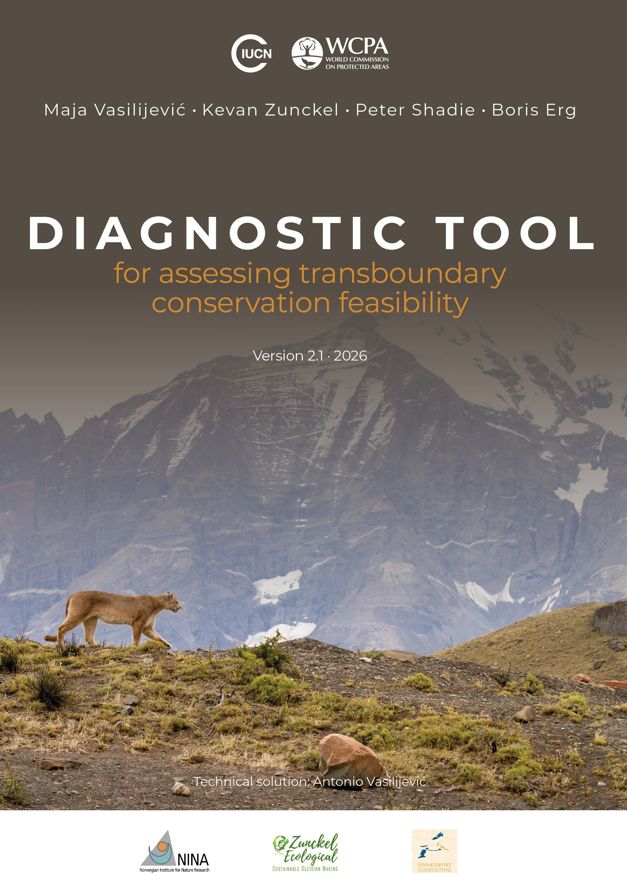
The Diagnostic Tool for Transboundary Conservation planners first appeared in 2012 in Erg, and since then it has been applied in many different transboundary conservation planning situations around the world. Each application has tested its usefulness as a generic tool in diverse circumstances and feedback has allowed it to be revised and updated a number of times since it was first developed. The most recent application known to the authors was for the development of a Transboundary Action Plan for the Phong Nha-Ke Bang National Park and Hin Nam No National Park World Heritage Property between Viet Nam and Laos People’s Democratic Republic, where valuable feedback has been applied to produce this updated version.
The Diagnostic Tool is an MS Excel based questionnaire in which the questions have been structured according to the four pillars of sustainability, i.e. natural, social, economic and governance. The questions are designed to test the feasibility of a potential transboundary conservation initiative and provide planners with an indication of the extent to which the initiative is or is not feasible. The answers to the questions are either quantitative and/or qualitative, where the qualitative answers are tallied to provide an overall score that broadly gives a green, orange or red light to the initiative. The qualitative answers provide substance that is captured in an automatically generated report structured to provide information on the:
• General background of the initiative;
• If there is a compelling ecological reason for the initiative;
• What the benefits and challenges are beyond the ecological reasoning;
• Who the relevant stakeholders are; and
• If there is capacity to work collaboratively across international borders.
The tool can be applied by an individual, a group of national stakeholders or a multi-national and multi-stakeholder group; with the latter being the most ideal use of the tool. With careful and strong facilitation, the tool may be used simultaneously as a situational and stakeholder analysis, incorporating knowledge and perspectives from as many relevant stakeholders as possible. Processes like this help to generate a shared understanding of the prevailing dynamics that will influence the establishment and management of a transboundary conservation initiative, while also helping to initiate and build trusting relationships between the stakeholders, both within and across the international boundaries.
The tool may also be applied retrospectively where it can test the effectiveness of establishment and management of a transboundary conservation initiative, although plans are in place to adapt to tool to be used as a management effectiveness tracking mechanism.
Transboundary conservation planners and practitioners who use the tool are encouraged to provide feedback to the authors who recognise that it is a living product that needs to be open to continuous improvement.
The tool may also be applied retrospectively where it can test the effectiveness of establishment and management of a transboundary conservation initiative, although plans are in place to adapt to tool to be used as a management effectiveness tracking mechanism.
Transboundary conservation planners and practitioners who use the tool are encouraged to provide feedback to the authors who recognise that it is a living product that needs to be open to continuous improvement.
For more information: Kevan Zunckel on kevanzunckel@gmail.com
• General background of the initiative;
• If there is a compelling ecological reason for the initiative;
• What the benefits and challenges are beyond the ecological reasoning;
• Who the relevant stakeholders are; and
• If there is capacity to work collaboratively across international borders.
The tool can be applied by an individual, a group of national stakeholders or a multi-national and multi-stakeholder group; with the latter being the most ideal use of the tool. With careful and strong facilitation, the tool may be used simultaneously as a situational and stakeholder analysis, incorporating knowledge and perspectives from as many relevant stakeholders as possible. Processes like this help to generate a shared understanding of the prevailing dynamics that will influence the establishment and management of a transboundary conservation initiative, while also helping to initiate and build trusting relationships between the stakeholders, both within and across the international boundaries.
The tool may also be applied retrospectively where it can test the effectiveness of establishment and management of a transboundary conservation initiative, although plans are in place to adapt to tool to be used as a management effectiveness tracking mechanism.
Transboundary conservation planners and practitioners who use the tool are encouraged to provide feedback to the authors who recognise that it is a living product that needs to be open to continuous improvement.
The tool may also be applied retrospectively where it can test the effectiveness of establishment and management of a transboundary conservation initiative, although plans are in place to adapt to tool to be used as a management effectiveness tracking mechanism.
Transboundary conservation planners and practitioners who use the tool are encouraged to provide feedback to the authors who recognise that it is a living product that needs to be open to continuous improvement.
For more information: Kevan Zunckel on kevanzunckel@gmail.com