
 Translate
News
Strengthening Resilience in SADC TFCAs: Launch of Mainstreaming DRM/RID Into TFCA Web-Based Training Module
25 March 2026
On 24 February 2026, more than 100 representatives from Transfrontier Conservation Areas (TFCAs), River Basin Organizations (RBOs), and Disaster Risk Management (DRM) institutions convened for a regional webinar under the 2023-2033 Southern African Development Community (SADC) TFCA Programme facilitated by the Deutsche Gesellschaft für Internationale Zusammenarbeit (GIZ) GmbH and supported by German Government and the European Union in partnership SADC. The session, themed “Building Land/Seascape Resilience in Southern African TFCAs and RBOs: Lessons from the Greater Limpopo Basin Flood Emergency”, focused on strengthening integration and effective management of transboundary landscapes and seascapes (SADC TFCA Programme Goal 1) and marked the official launch of a new web-based training course on mainstreaming Disaster Risk Management and Risk-Informed Development (RID) into TFCAs.
TFCAs are collaborative conservation initiatives recognised under the 1999 SADC Protocol on Wildlife Conservation and Law Enforcement, which span international borders, enabling neighbouring countries to jointly manage shared natural and cultural resources. To operationalise the above, the 2023–2033 SADC TFCA Programme a revision of the 2012-2022 programme aims to build a functional and integrated network of TFCAs where shared resources are co-managed sustainably and recognised as foundations for economic development, human well-being, and resilience. Mainstreaming Disaster Risk Management and Risk-Informed Development into TFCA planning, initiated in 2024, ensures that conservation and development decisions are based on clear understanding of risk.
The transboundary flood emergency that struck the Limpopo Basin in late January 2026 underscored the urgency of this work. Prolonged and intense rainfall led to widespread flooding across the basin, affecting the Great Limpopo TFCA, the Greater Mapungubwe TFCA, and much of the river system coordinated by the Limpopo Watercourse Commission (LIMCOM). The floods impacted parts of South Africa, Zimbabwe, and Mozambique. Reports across different government mediums highlighted massive human displacement, loss of life, damages to homes, infrastructure, and agricultural lands. Governments declared States of Disaster and issued Red Alerts as rivers overflowed and communities became isolated. The event demonstrated the interconnected nature of shared river basins: upstream conditions directly influence downstream impacts, requiring coordinated, cross-border responses. Such events require a systematic effort to identify, assess, and reduce disaster risks before hazards escalate into crises and emphasize the need for risk-informed development approach to ensure that decisions on infrastructure, land use, and conservation management are based on an understanding of current and future risks, including those linked to climate variability and change.
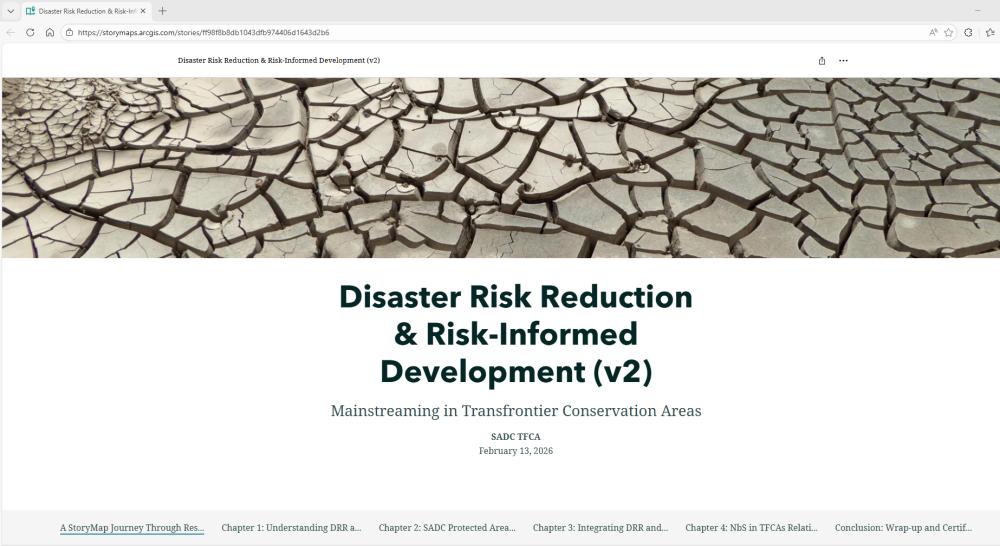
The webinar provided a platform for shared reflection and forward-looking collaboration. The Acting Head of the SADC Disaster Risk Reduction Unit Ms. Nana N. Dlamini delivered the opening remarks and Dr. Eddie Riddell, Regional Coordinator of LIMCOM, outlined the hydrological drivers of the floods and the coordination challenges faced across borders. Dr. Tercia Strydom of the South African National Parks (SANParks) and the Great Limpopo TFCA shared practical insights on disaster preparedness from a conservation management perspective, highlighting the growing need to integrate ecological stewardship with emergency planning and community resilience. A key milestone of the session was the launch of a 60-minute online training course on mainstreaming DRM and DRR into TFCAs, developed to support practitioners across Southern Africa, the course combines video presentations, case studies, and practical tools to guide stakeholders in embedding risk considerations into planning and decision-making processes and can still be undertaken from the below Disaster Risk Reduction & Risk-Informed Development (v2) link advertised within the TFCA Network Website
The webinar reaffirmed a central message: resilient ecosystems and resilient communities are mutually reinforcing. Effective transboundary cooperation, linking upstream and downstream actors, conservation authorities, water managers, and disaster management institutions is essential for safeguarding lives, livelihoods, and biodiversity. Mainstreaming Disaster Risk Management and Risk-Informed Development into transboundary conservation is no longer optional, it is strategic investment in sustainable development, regional integration, and long-term resilience.
For more information: Onkemetse Joseph on onkemetse.joseph@giz.de
The transboundary flood emergency that struck the Limpopo Basin in late January 2026 underscored the urgency of this work. Prolonged and intense rainfall led to widespread flooding across the basin, affecting the Great Limpopo TFCA, the Greater Mapungubwe TFCA, and much of the river system coordinated by the Limpopo Watercourse Commission (LIMCOM). The floods impacted parts of South Africa, Zimbabwe, and Mozambique. Reports across different government mediums highlighted massive human displacement, loss of life, damages to homes, infrastructure, and agricultural lands. Governments declared States of Disaster and issued Red Alerts as rivers overflowed and communities became isolated. The event demonstrated the interconnected nature of shared river basins: upstream conditions directly influence downstream impacts, requiring coordinated, cross-border responses. Such events require a systematic effort to identify, assess, and reduce disaster risks before hazards escalate into crises and emphasize the need for risk-informed development approach to ensure that decisions on infrastructure, land use, and conservation management are based on an understanding of current and future risks, including those linked to climate variability and change.
The webinar provided a platform for shared reflection and forward-looking collaboration. The Acting Head of the SADC Disaster Risk Reduction Unit Ms. Nana N. Dlamini delivered the opening remarks and Dr. Eddie Riddell, Regional Coordinator of LIMCOM, outlined the hydrological drivers of the floods and the coordination challenges faced across borders. Dr. Tercia Strydom of the South African National Parks (SANParks) and the Great Limpopo TFCA shared practical insights on disaster preparedness from a conservation management perspective, highlighting the growing need to integrate ecological stewardship with emergency planning and community resilience. A key milestone of the session was the launch of a 60-minute online training course on mainstreaming DRM and DRR into TFCAs, developed to support practitioners across Southern Africa, the course combines video presentations, case studies, and practical tools to guide stakeholders in embedding risk considerations into planning and decision-making processes and can still be undertaken from the below Disaster Risk Reduction & Risk-Informed Development (v2) link advertised within the TFCA Network Website
The webinar reaffirmed a central message: resilient ecosystems and resilient communities are mutually reinforcing. Effective transboundary cooperation, linking upstream and downstream actors, conservation authorities, water managers, and disaster management institutions is essential for safeguarding lives, livelihoods, and biodiversity. Mainstreaming Disaster Risk Management and Risk-Informed Development into transboundary conservation is no longer optional, it is strategic investment in sustainable development, regional integration, and long-term resilience.
For more information: Onkemetse Joseph on onkemetse.joseph@giz.de
More information: https://storymaps.arcgis.com/stories/ff98f8b8db1043dfb974406d1643d2b6